
KONGO CAMPUS: THE PLEASURE OF NOSTALGIA (1976-1979).

----------------------------------------
Let me begin from the beginning. What is the origin of the name "Kongo Campus"? One initial theory was, it came from the Congo Republic, where Nigerian soldiers helped stabilise that nation's independence from 1960 to 1964 under the UN supervision, just like Dodan Barracks is named after the territory in the Arakan Peninsula of Burma (now Myanmar), Bukavu Barracks (named after a town in the Congo), Mogadishu Barracks (named after the capital of Somalia), etc.
Historians however stated that Kongo (distinct from the nation Congo) was a tribe indigenous to the area covered by Tudun Wada, Zaria that had lived there for centuries, where the campus is located. This version has been officially accepted for the records.
On 3rd May 1946, the Resident of Zaria represented the Lieutenant-Governor of the Northern Region to declare open the Clerical Training Centre, Zaria. It was built by the colonial authorities to help the Northern Region train and retrain its own clerical and secretarial staff, native authority administrators, alkali courts personnel, etc. It is the oldest institution of higher learning in West Africa devoted to the teaching of Management, Accounting, Administration and Law. In the course of time, the institution kept growing until it became the Institute of Administration, the precursor of the parent Ahmadu Bello University. It is now the home of two faculties of the ABU (Law & Administration), the Centre for Islamic and Legal Studies as well as several other certificate courses.
The pioneer director of the institute was Professor S.S. Richardson (1961-1967), a Briton and a very formidable legal draftsman who annotated the Penal Code and the Criminal Procedure Code of Northern Nigeria. He was succeeded by Dr Mahmud Tukur (1967-1975) who moved to become the pioneer VC of the newly upgraded Bayero University, Kano. Dr Sulaiman Kumo was the 3rd director (1975-1980) and was in charge when we reported as fresh Law students in 1976. There was one Malam Nuhu Bayero, an elderly Zaria prince, who had an office within the Law Quadrangle marked "Pro-Chancellor, University of Lagos." The Dean of the Faculty of Law was Prof. M. A. Mannan, an Indian who was very well-versed in Constitutional Law. He succeeded Prof M.I. Khaleel, a Sudanese and an acclaimed authority on Criminal Law, who played a significant role in the preparation of the Northern Nigeria Penal Code and the Criminal Procedure Code.
At the period under discussion, some of the structures I can recall at the Kongo Campus were the following:
1. Students' Hostels:-
----------------------------------------
Hostel 1
Hostel 2
Hostel 3
Ghetto Hostel (all for male students).
Sardauna and Bedde Hostels (for female students). Unlike at the Samaru Main Campus where each hostel (called "hall") had its dedicated dining hall, the hostels at Kongo were adequately served by 3 dining halls located at Hostels 1, 3 and Ghetto, serving both male and female students. Meals served thereat were fit for royalty, especially dinner on Saturdays where students carried no less than 5 plates of different dishes on their trays. The weekly laundry service was impeccable. Due to the inadequacy of accommodation, second-year students were directed to stay off-campus in rented apartments. However, most of them opted for "squatting," meaning to share the single rooms in Hostels 1, 2 & 3, or the double rooms at Ghetto. Others secured the boys' quarters of the staff quarters. Only married students actually stayed off-campus.
There was also a Mini-Hostel for postgraduate students.
2. The Conference Centre:-
----------------------------------------
The Conference Centre was partly provided for lecturers yet to secure permanent staff quarters. There was a Reception leading to the lecturers' rooms for their leisure, furnished with comfortable sofas, newspapers, journals and a large black and white TV set. Due to the absence of common rooms in the students' hostels (unlike at Samaru, where each hostel had its furnished Common Room), on most occasions, the students would take over the place, especially on Saturday evenings when NTA Kaduna was showing the 30-minute satirical Nigerian Army comedy, Samanja Mazan Fama, led by the late Usman Baba Pategi and his team. The place would be so crowded with students, some sitting on the sofa, some standing and others sitting on the floor, that a lecturer would have to ask for a path to be able to enter his room !
3. The Suya Joint:-
----------------------------------------
Attached to the Conference Centre was "The Suya Joint," a barbecue outfit where staff, students and even outsiders frequented for the tasty roast meat. It was the most hygienic roast meat kitchen I know till date. The chef selected a secluded area to avoid dust, also built a wire net around the fire-place to keep off flies and fixed a tap head inside the enclosure for water supply to keep the meat and his utensils clean. Available grilled varieties were beef, liver, kidney or entrails. I know a colleague whose name I won't mention in the interest of peace, who spent his entire "bulgaria" on daily trips to the delicacy joint. I still can't tell who was the greatest beneficiary between the customers who had a swell time, and Sule Mai Nama who daily smiled to the bank !
4. C. I. L. S.
------------------------
The Centre for Islamic Legal Studies had the only main Lecture Theatre on the campus. It also had a well-stocked library. There was a smaller theatre at the Business School. First year Law Students had all their lectures at the CILS, considering their large number.
5. J.F.K. Main Library:-
----------------------------------------
Sardauna Ahmadu Bello was said to have personally visited President J.F. Kennedy of the United States to request for the establishment of a library at the Kongo Campus. The President was said to have granted approval immediately. However, before the library was completed, Kennedy was assassinated. The Sardauna was filled with grief that Kennedy could not witness the realisation of the great project. On 4th April 1964, the Sardauna personally opened the library, naming it after the slain US President who was a great friend of Nigeria.
6. The University Bookshop:-
----------------------------------------
The University Bookshop was a highly subsidised, well-stocked source of education materials for the students. It provided professional and general knowledge books and other publications.
7. The Campus Clinic:-
----------------------------------------
The Campus Clinic was headed by a lady doctor, a tall, lean, grumpy, unsmiling white woman. Somehow, the students felt that whatever ailment a patient presented, the woman would prescribe malaria drugs. Students therefore felt that unless you were sure you had malaria, you had better gone to the Teaching Hospital for proper diagnosis and treatment. Certainly her not-so-friendly disposition must have added to that apathy.
8. The Love Garden:-
----------------------------------------
The Love Garden was set up strategically facing the female hostel. Boys who had a free period used to pass the time there, watching the human traffic going to and fro. Some called it "bird-watching," perhaps considering the close relationship between birds and gardens !
9. Sports Facilities:-
----------------------------------------
In the field of sports, the campus had a standard football field, swimming pool, badminton and fives courts (the last game being Sardauna's favourite sport) and others. A story was told of a student during the colonial days who nearly drowned in the swimming pool. In an attempt to impress a girl he fancied, he ventured into the deep side even though he couldn't swim. He was narrowly saved by his friends. I never got to know if he was able to win the girl's heart despite the gaffe ! Perhaps that was why even during our days, there was a swimming coach, from 12 noon to 6 pm on weekdays on standby, in case of emergencies !
10. The Estate Department:-
----------------------------------------
The Estate Department was adequately staffed by expert tradesmen. Carpenters, electricians, plumbers and other relevant technical personnel were ever on hand to fix whatever was faulty without delay.
11. Kilometre 101:-
----------------------------------------
One unforgettable life-saver for all Kongolites was the only kiosk available within the walls of the campus called "Kilometre 101." I never got to know what that meant or why Malam Ibrahim inscribed that on the front of his provisions kiosk, but what I knew for sure was, some students might have died of late night hunger if that kiosk didn't exist. Well-located in front of the CILS, it was easily accessible to the two faculties. From early morning till midnight, the kiosk was open for bread, groundnut, guguru, cake, Fanta, Coke, biscuits, sweets, sardines, geisha and most other imaginable edibles. After reading till midnight, returning from the cinema or whatever engagement would keep one up till so late, one was sure to see the kiosk open. A bottle of mineral was 10 kobo while one cake (the size of Peak milk tin) was also 10 kobo, so with 20 kobo, one could quench a nocturnal hunger that would have prevented sound sleep. Malam Ibrahim knew almost all his customers by name, was so jovial that even if you were not buying anything, you would stop by and share a joke. Students would gather there to listen to his radio permanently tuned to FRCN Kaduna, especially Halilu Getso's political programme, Dandalin Siyasa. Malam Ibrahim was a staunch supporter of Malam Aminu Kano's PRP. He had a shop boy called Hanafi who never spoke unless it was necessary.
12. New Buildings for Law Faculty & Conference Centre:-
----------------------------------------
In 1976, foundations were laid for the new Faculty of Law and a full-fledged hotel to replace the Conference Centre. By 1978, the structures were completed and we became the first occupants of the present-day Faculty of Law. The old building was dedicated solely for the Area Courts Judicial Training.
The Kongo Conference Hotel became open to the public while the old Centre was made postgraduate students hostel.
One tradition worthy of mention was the Moot Court Competition, set to train the junior law students in advocacy. In 1977, as we were concluding our first year as law students, the Dean of the Faculty of Law would select any subject in law for debate by the students, from contractual obligations, constitutional issues, crime and punishment, etc. Participating students would be eliminated until the final two emerged. A prominent lawyer would be invited to act as judge in the mock trial. The subject chosen in our set was culpable homicide (criminal law). The two lucky finalists were Muhammad Tabi'u (who was assigned the prosecution counsel) and Gambo Danmusa (as the defence counsel). The venue was the CILS Lecture Theatre which was filled to capacity by law students from all three classes (Parts 1 to 3).
The Presiding Judge was Alhaji Dahiru Mustapher, the Solicitor-General, Ministry of Justice, Kaduna. The combatants argued fiercely. In the end of the hearing, the judge said the prosecution had proved its case beyond reasonable doubt and found the accused guilty of manslaughter. I think he sentenced him to a prison term of 10 or so years. The Dean gave the prosecutor the first prize and the defence attorney was the runner up. That trial judge later became Justice Dahiru Mustapher, (now late), the 12th Chief Justice of Nigeria (2011-2012). The prosecuting counsel today is a law professor and S.A.N., while the defence counsel is a former Hon. Member, House of Representatives. A famous p7 plays will be what he will actualise in his adulthood." It turned out that all the participants in that mock trial have reached the pinnacle of their careers.
Today, the Institute of Administration Zaria, established nearly 80 years ago, offers undergraduate and postgraduate studies, diplomas, certificates, research, in-service training programmes, etc. It is the second largest campus of the ABU Conglomerate (being Samaru, Kongo & SBRS Funtua).
I conclude by mentioning the role played by the neighbouring Gyallesu Quarters in the life of Kongolites. What Kilometre 101 could not provide us on the campus, we strolled to Banadeen Supermarket just outside our gate at Gyallesu to buy. Off-campus students rented premises there so they would remain within walking distance from the school, just as Samaru Village remains to the Main Campus.
A surprising similarity between Samaru and Kongo cannot be overlooked. The Main Campus has Samaru Village, Kongo has Gyallesu Quarters. The Main Campus has Nakowa Supermarket by the gate, Kongo has Banadeen Supermarket by the gate. The Main Campus has 3 gates (Police, Main & North gates), Kongo has 3 gates (Main, Ghetto & Estate Dept gates).
A history of Kongo will be incomplete without a mention of Shagalinku Restaurant. It was a locally-built mud-house having the traditional "soro" or "zaure" with mats spread on the floor for those who preferred to eat the local way. Inside was a room with ramshackle tables and chairs for those who chose the modern way. During our stay in the '70s, it was the only famous eatery in the whole of Tudun Wada Zaria, serving local and foreign delicacies. Again I recall a friend (who also remains anonymous) who could never pass a plate of "kwai da hanta" (eggs & liver mix). The eatery was set up by an indigene of Rogo in Kano State, which borders Zaria. It later grew to a chain with branches in Kano, Kaduna and Abuja.
We are duty-bound to keep seeking Allah's mercy, favour and blessings on our distinguished predecessors like the Sardauna and his worthy lieutenants, who prioritised our interests over theirs, who left for us invaluable legacies, who suffered so that we, the coming generations, would neither lack nor lag. May they be resting in the best of Heavenly Gardens. May we, at our time of departure say, it is indeed better we had lived, amin.
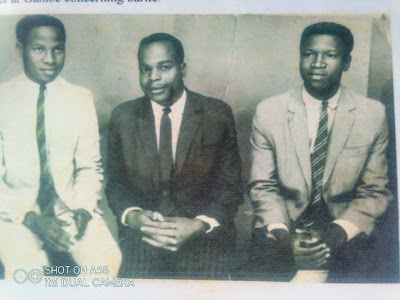
I hereby attach my JFK Library ID card for the memories of good old times.
Saeed Muhammad Koki.

Comments
Post a Comment
Northern Nigeria Perspective is welcoming all comments, observations or views. The use of foul/vulgar language, pornographic materials and such other inappropriate comments are not allowed